
You’re probably here because you keep losing fights that feel winnable.
Your crosshair is on target. You shoot first. Then some guy slides through the doorway, deletes you in what feels like half a second, and the killcam shows a weapon you haven’t touched in months. That isn’t just aim diff. A lot of the time, it’s a loadout diff.
That’s what separates casual frustration from ranked consistency. Players who understand the meta stop guessing. They know which guns win at which ranges, which builds fix a weapon’s weakness, and when a good Multiplayer gun becomes a bad Battle Royale pick. If you want a real call of duty mobile best guns guide, that’s the only way to do it.
Table of Contents
- Dominating the Lobby Starts with Your Loadout
- Understanding What Makes a Gun The Best
- The Best Assault Rifles for Mid-Range Dominance
- Winning Close-Quarters Fights with SMGs and Shotguns
- Controlling the Map with Snipers and LMGs
- Choosing the Right Gun for Battle Royale and Multiplayer
- Your Instant Arsenal and Next Steps
- Frequently Asked Questions About CODM Guns
Dominating the Lobby Starts with Your Loadout
A lot of players blame themselves for every lost gunfight. Sometimes that’s fair. Most of the time, it isn’t.
You can have solid aim and still get farmed if your weapon takes too long to kill, aims too slowly, or falls apart once recoil kicks in. CODM punishes bad setups harder than most players admit. A gun that feels “fine” in public matches can turn into dead weight in ranked when everyone else is running tuned builds.
I see the same mistake constantly. Players pick a gun because it used to be good, or because a skin looks clean, then they slap on attachments that fight each other. One attachment helps recoil. The next one kills mobility. The last one tanks aim speed. The result is a weapon that’s mediocre at everything.
Practical rule: If your gun doesn’t win the first range you built it for, the build is wrong.
That’s why the best loadouts feel unfair. They have a job, and every attachment supports that job. A close-range SMG should snap fast, move fast, and stay controllable in a panic spray. A mid-range AR should beam without turning into a brick. A BR weapon needs different priorities than an MP weapon because the fights aren’t the same.
Here’s the mindset you need:
- Build for one primary lane: Decide whether the gun is for close, mid, or long range.
- Fix the weapon’s weakness first: If the gun already hits hard, improve handling or stability.
- Protect your kill speed: Don’t overload a build with comfort attachments that make the gun lose fights.
- Test in motion: Standing still in the firing range lies. Strafe, snap, and re-center.
The players who dominate lobbies aren’t always the fastest aimers. They’re the ones using weapons that do exactly what the match asks for.
Understanding What Makes a Gun The Best
The best gun isn’t just the one with the biggest damage number. It’s the one that turns real fights into consistent wins.
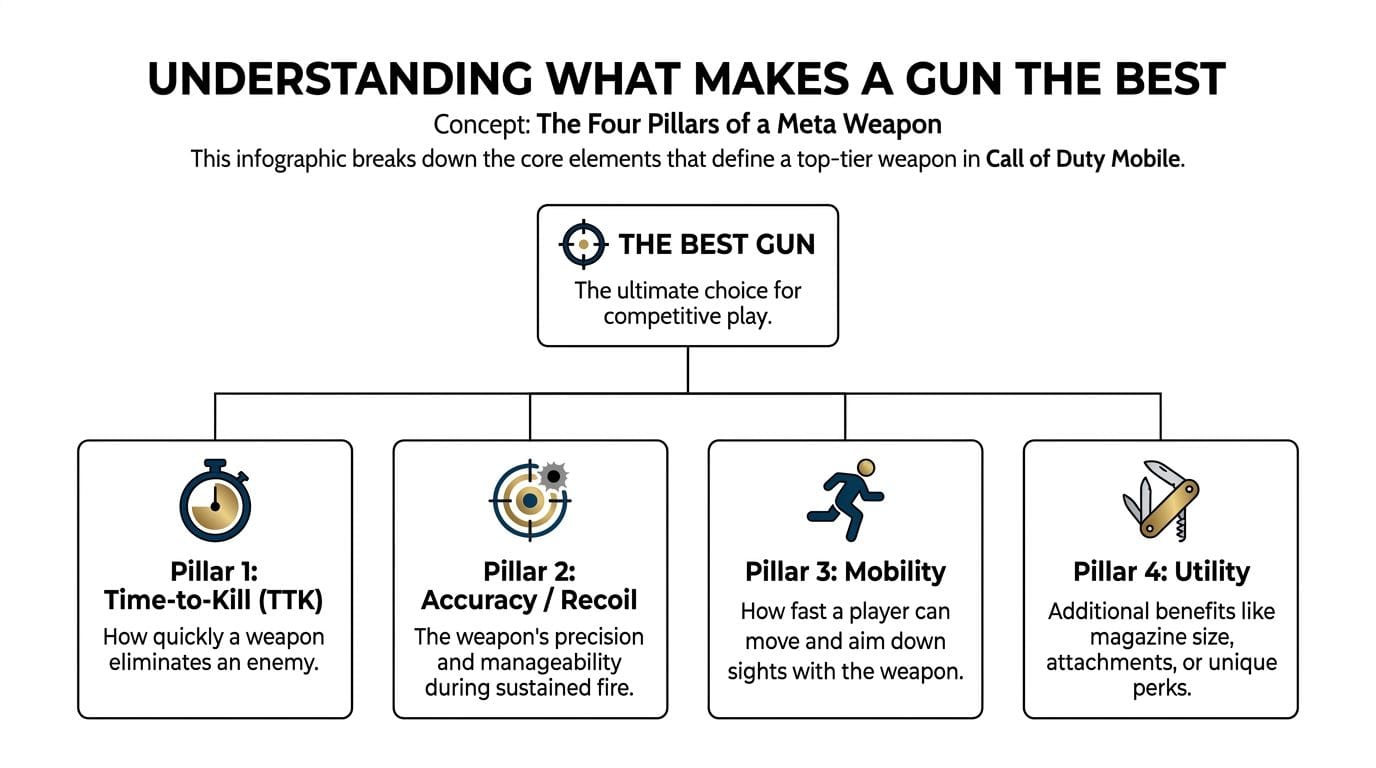
When I evaluate weapons, I care about four things. Not because they sound technical, but because every gunfight in CODM comes down to them.
TTK decides who wins first
TTK, or time-to-kill, is the core stat. If two players spot each other at the same time, the gun with the faster practical kill speed usually wins.
But practical is the key word. The theoretical fastest gun on paper can still feel bad if it needs perfect headshots or falls apart once recoil starts. That’s why I don’t judge TTK in isolation. I judge whether I can hit that TTK in a live fight.
Think of TTK like a race car. Top speed matters. If the car can’t corner, you’re still losing.
ADS and mobility decide whether you get to shoot
ADS speed is how fast you get your gun ready. In close and mid-range fights, that matters almost as much as raw damage.
A weapon with strong damage but sluggish handling often loses before the first bullet lands. That’s also why mobility matters. Strafe speed, sprint-to-fire feel, and general responsiveness all change whether you survive peeking a corner.
Short version:
| Factor | What it changes | Why it matters |
|---|---|---|
| ADS speed | First-shot readiness | Faster reaction in sudden fights |
| Mobility | Positioning and dueling flow | Easier peeks, chases, and disengages |
| Sprint response | Recovery after movement | Critical for aggressive routes |
Fast guns create chances. Slow guns need perfect timing.
Recoil and range decide whether your damage is real
A weapon can hit hard and still be useless if it kicks sideways like crazy. Recoil control and bullet spread accuracy decide whether your shots land where you think they will.
Then there’s effective damage range. That’s the point where your weapon stops behaving like the gun you built. Maybe it needs extra bullets. Maybe it loses consistency. Maybe it stops punishing sloppy enemy movement.
Use this quick framework when judging any gun:
- Can it kill fast enough to matter?
- Can I aim it quickly enough for my mode and playstyle?
- Can I hold the recoil under pressure?
- Does it still work at the ranges you fight in?
If a gun checks all four boxes, it’s meta. If it only checks one or two, it’s a pub match toy.
The Best Assault Rifles for Mid-Range Dominance
If you want one class that can carry your ranked climb, pick assault rifles. They’re the least forgiving to build badly and the most rewarding when built right.
Mid-range is where most Multiplayer fights are decided. Not point-blank chaos. Not full-map beams. That space in between. If your AR owns that zone, you control more of the match.
SO-14 is still the ranked king
The SO-14 remains the best AR pick if you want reliability. According to this Season 3 breakdown of CODM meta weapons, it has stayed top-tier through Season 3 (2026) because of its 60 base damage, infinite five-tap range capability, and the fact that it still dominates even after a 10% nerf to bullet spread accuracy.
That same breakdown also points to the core reason it’s oppressive. The SO-14 combines elite kill potential with SMG-like mobility, strong bullet spread accuracy, faster ADS than you’d expect, and a massive attachment pool that lets players keep adapting it.
My advice is simple. Build the SO-14 to preserve what already makes it broken.
Recommended SO-14 MP build
- Monolithic Suppressor: Extends your pressure window and keeps your shots cleaner in lane fights.
- Longest or range-focused barrel: Lean into the weapon’s natural mid-to-long control.
- No Stock or mobility stock: Recover handling so the rifle doesn’t feel heavy.
- Granulated Grip Tape: Tightens long sprays and makes the gun more stable when recoil stacks.
- Extended Mag: Keeps you in the fight longer, especially in objective modes.
Why this works: you’re not trying to turn the SO-14 into a hip-fire rusher. You’re preserving its damage profile and making sure the gun still feels fast enough to challenge aggressive players.
UL736 is the aggressive sleeper that stopped being a sleeper
The UL736 got pushed into real meta territory by its Season 3 buff. In this testing-focused video, the weapon is described as gaining a new damage phase that deals 30 damage out to 16 meters before attachments, which enables a guaranteed three-tap kill with one headshot at that range. The same source also notes benchmark performance with sub-600ms kills, a 354ms ADS speed, and a 210ms prime TTK in the tested setup.
That matters because the UL736 now punishes close-to-mid fights much harder. It’s less fussy than a lot of “skill cannon” rifles. You can play fast with it and still have enough control to challenge anchors.
Recommended UL736 aggressive build
- Monolithic Suppressor: The cited testing notes bullet velocity gains with this attachment, which helps the rifle feel cleaner at mid-range.
- RTC Light Muzzle Brake: Helps settle recoil.
- Mobility stock or rear grip: Speeds up handling so the rifle stays snappy.
- Extended Mag II: Lets you sustain pressure.
- ADS laser or handling perk: Helps you get on target faster.
This one is for players who like pushing power positions, not sitting behind cover waiting for mistakes.
A quick look at the difference:
| Gun | Best use | Build priority | Player type |
|---|---|---|---|
| SO-14 | Ranked consistency | Range plus stability | Methodical slayers |
| UL736 | Fast lane pressure | ADS plus recoil balance | Aggressive entry players |
If you want to see how different playstyles shape loadouts, watch this before you lock in a build.
A practical AR setup rule
Don’t overbuild for recoil. A lot of players ruin strong ARs by making them too slow.
If your AR wins long range but loses every doorway fight, you didn’t build a rifle. You built a burden.
For most players, the right AR setup is one recoil aid, one range aid, one handling fix, one magazine choice, and one flex slot. Keep the gun honest. Let the base stats do the heavy lifting.
Winning Close-Quarters Fights with SMGs and Shotguns
Close-range fights aren’t about elegance. They’re about who gets damage on target first and keeps it there.
That’s where players usually split into two camps. The first wants pressure, forgiveness, and repeatable entries. The second wants pure burst damage and trusts their movement enough to make one shot count.

Pick an SMG if you want repeatable pressure
SMGs are the smarter choice for most players in Hardpoint, Domination, and small-map chaos. They give you room to make a small mistake and still recover through fire rate and movement.
The build philosophy is straightforward:
- Prioritize ADS first: Your gun has to be up immediately when someone swings.
- Keep recoil manageable, not perfect: In close range, too much stability often costs you more than it gives back.
- Use a bigger mag if you chain fights: Reloading after every kill gets you traded.
Good underrated options can work here too. The problem is most guides stop at “this gun is viable” and never show the exact attachment combo that makes it viable. That’s why so many players try an off-meta SMG once, hate it, and never touch it again.
Pick a shotgun if you trust your first shot
Shotguns are for players who understand spacing and commit fully. If your movement is sharp and you know how to force tight angles, a shotgun turns objectives into traps.
The HS0405 deserves attention because post-Season 9 buffs pushed shotguns up in both modes, but a lot of discussion still treats them like niche picks. In practice, they’re brutal when the map forces close corners, door frames, and head-on entries.
Recommended shotgun build priorities
- Hip-fire support: You want cleaner panic shots in tight rooms.
- Mobility attachment: Helps you close distance before the enemy AR settles.
- Range extension: Gives you more forgiveness on that first blast.
- Reload or shell support: Important if you stay in contested objectives.
Use a shotgun when the map gives you funnels. Don’t force it on wide lanes and expect miracles.
The best close-range weapon isn’t the one with the scariest damage. It’s the one you can trust while sliding into a bad fight.
If you’re unsure which side suits you, ask one question. Do you want to win through sustained pressure or instant punishment? That answer picks your class for you.
Controlling the Map with Snipers and LMGs
Long-range control comes in two forms. You either delete one player at a time with precision, or you make an area unplayable through constant fire.
Both work. They just reward different habits.
Snipers reward confidence and route knowledge
A sniper is strongest when you already know where players want to be. That’s why average snipers miss shots they “should” hit. They aim at bodies, but great snipers aim at routes.
Your build should support fast target acquisition, not comfort. Go lighter. Favor quicker ADS. Don’t overstack stability unless the rifle already feels wild.
A clean sniper setup should do three things:
- Get into scope fast
- Stay centered after movement
- Recover quickly after the shot
For BR, keep one sniper in your pocket if you’re patient and like holding power positions. For MP, bring it when the map gives you predictable lanes and your team benefits from a pick-focused style.
LMGs win by denying space
LMGs aren’t about flashy clips. They’re about making enemies stop pushing where they want to push.
That’s why a good LMG build should feel like a mounted turret without locking you in place. You want recoil stability and enough ammunition to keep a lane sealed, but not so much bulk that you can’t rotate off a bad angle.
Use an LMG when:
- Your team needs anchor presence: Hold head glitches, long cuts, and objective crossfires.
- Enemies keep flooding the same route: Sustained fire punishes predictable pushes.
- You’re playing defense-heavy modes: The weapon’s value rises when you can pre-aim.
A simple comparison helps:
| Style | Best for | Build focus |
|---|---|---|
| Sniper | Picks and sightline control | ADS and centering |
| LMG | Suppression and objective lockdown | Recoil and magazine support |
Don’t confuse “long range” with “slow.” A good long-range setup still needs a plan for repositioning. If you win one lane and die rotating, your build did half the job.
Choosing the Right Gun for Battle Royale and Multiplayer
A single universal best gun doesn’t exist. That idea survives because it’s easy, not because it’s true.
Multiplayer and Battle Royale ask for different things. MP is tighter, faster, and more repetitive. BR stretches fights out, adds vehicles, changes sightlines, and punishes weapons that only feel good at one exact distance.
Why one loadout never fits both modes
In MP, your weapon has to be ready instantly. ADS speed, snap response, and quick handling matter because most fights happen before you can reset.
In BR, the fight often starts earlier and lasts longer. You care more about sustained accuracy, cleaner damage over distance, and whether the weapon still works when the target is moving through open terrain or around vehicles.
That gap is badly covered in a lot of call of duty mobile best guns lists. This discussion of overlooked BR versus MP weapon viability points out that guides rarely quantify how underrated guns perform by mode, including the XPR50’s 2-shot kill potential in BR zones. That same analysis also notes the ISO as a close-quarters BR option with a high fire rate and workable medium-range accuracy.
Guns that gain value in BR
Some weapons become better the second you leave Multiplayer.
Take the XPR50. In MP, many players ignore it because it doesn’t fit the quick, pick-heavy sniper expectations many players want. In BR, where lines of sight open up and tempo shifts, a rifle like that can gain real value if you know how to position.
The ISO is another example. In standard MP discussions, it can get crowded out by flashier choices. In BR, an SMG with fast output and enough stability for aggressive pushes can earn a spot as a secondary.
What changes in BR builds:
- Range matters more: You’ll lose too much value with pure close-range setups.
- Sustained control matters more: Follow-up shots and longer tracking matter.
- Versatility matters more: You need answers for open-field pressure and surprise close fights.
A simple mode split for your arsenal
Don’t keep one favorite gun and force it into both queues. Keep a clear split.
For Multiplayer
- Use fast-handling ARs and SMGs
- Bias toward ADS and strafe responsiveness
- Build for repeat engagements and quick peeks
For Battle Royale
- Use stable ARs, flexible snipers, and dependable secondaries
- Bias toward range, control, and follow-up consistency
- Build for mixed distances and awkward terrain fights
If your MP gun feels amazing and your BR results still feel random, that isn’t bad luck. You’re probably carrying the wrong build into the wrong mode.
Your Instant Arsenal and Next Steps
The core lesson isn’t “copy this gun and you’re done.” It’s understanding why some weapons keep winning after patches while others disappear the second the meta tightens.
The best players do two things well. They identify what a gun is supposed to do, and they only use attachments that help it do that better. That’s why they adapt faster than everyone else when balance changes hit.
A lot of content still misses the most useful part. It names underrated weapons, calls them fun, and stops there. This analysis of loadout gaps for underrated guns makes that problem clear by pointing out that players keep asking for exact perk and attachment combos to make non-meta guns competitive, but most coverage never gives them.
That matters because testing takes time. Acquiring everything takes even more time. If you enjoy that process, great. Spend the hours in the range, tune your builds, and learn every recoil pattern yourself.
If you don’t, then be honest about it.
Some players want to play ranked with strong gear now. Some want a collection that already includes premium weapon options, rare cosmetics, and pre-built variety for MP and BR. Some content creators just want an arsenal that looks good on stream without months of grinding behind the scenes. That’s a rational shortcut, not a moral crisis.
Smart players don’t just chase the meta. They reduce the time it takes to get meta-ready.
Keep your approach simple:
- Pick your main mode first: MP and BR need different priorities.
- Choose one anchor weapon per class: One AR, one CQC gun, one long-range option.
- Tune by feel, not hype: If a build slows you down too much, change it.
- Re-test after patches: A small weapon change can flip a class hierarchy fast.
If you start thinking that way, you won’t need a new tier list every week. You’ll be able to judge weapons for yourself.
Frequently Asked Questions About CODM Guns
What’s the best gun for most players right now
If you want the safest answer, it’s the SO-14. It has the mix of damage, range presence, and adaptability that wins across a lot of Multiplayer situations. It’s the easiest recommendation for players who want one rifle that covers mistakes and still rewards good aim.
What’s the most forgiving gun for a beginner
A stable assault rifle is the best starting point. New players usually do better with a weapon that handles multiple ranges and doesn’t force perfect movement. Pick a rifle build with balanced recoil and decent ADS instead of chasing high-risk weapons too early.
Are mythic and legendary guns stronger
The skin tier doesn’t automatically make a weapon better in a match. What matters first is the base gun and the build. Premium blueprints can look better, feel cleaner, and offer a stronger presentation, but they don’t replace smart loadouts or positioning.
How often does the meta change
It changes whenever patches, buffs, nerfs, or new weapon releases shift class balance. Some top guns survive multiple updates. Others fall off immediately. The smart move is to revisit your core builds whenever a season changes and test whether your old setup still wins the fights you care about.
If you’d rather skip the grind and jump straight into optimized, premium-ready CODM loadouts, check out IceSoul. It’s a practical option for players who want curated accounts with mythic and legendary weapons, rare skins, and a faster path to a meta-ready arsenal without spending weeks acquiring everything by hand.
Enhanced by the Outrank app