
You’re probably in one of two spots right now. Either you’re tired of watching old lucky draws and mythic releases that you can’t realistically rebuild from scratch, or you want a ranked-ready account without spending months grinding a fresh profile.
That’s exactly why people look at cod mobile accounts in the first place. They want instant access to weapons, skins, operators, and progress that would take years to assemble the normal way. That can be smart. It can also go badly if you buy like a desperate player instead of a careful one.
I’ve seen the same mistakes over and over. People chase the cheapest listing, trust random DMs, skip basic checks, then act shocked when the seller pulls the account back. If you’re going to buy, buy like someone who plans to keep the account.
Table of Contents
- Why Buy A COD Mobile Account
- Decoding Account Value and Features
- Vetting Sellers and Verifying Legitimacy
- The Secure Purchase and Account Transfer
- Securing Your New Account Post-Purchase
- Understanding Inherent Risks and Terms of Service
- Frequently Asked Questions About Buying CODM Accounts
Why Buy A COD Mobile Account
Most buyers don’t start with some big plan. They hit the same wall. They want one specific mythic, one old legendary operator, or a stacked multiplayer loadout, then realize the account they built casually can’t get them there fast.
Time matters more than people admit
A fresh account sounds fine until you remember what you’re missing. Old event rewards are gone. Past seasonal cosmetics are gone. A lot of the fun gear that makes an account feel personal isn’t something you can just grind out this weekend.
That’s why buying an account often makes more sense than starting from zero. You’re not just paying for cosmetics. You’re paying to skip dead time.
Practical rule: If you care more about playing with a finished collection than building one slowly, a pre-owned account is the cleaner move.
New players and veterans buy for different reasons
New players usually want a head start. They want a decent rank base, a solid gun pool, and enough good skins that the account doesn’t feel empty.
Veterans usually want the opposite. They already know the game. They want access to items that are hard or impossible to reconstruct today, especially older mythics, legendaries, and limited cosmetics.
For creators, there’s another reason. A stacked account gives you more loadout variety on stream, more visual appeal in clips, and more reasons for people to watch. You don’t need to explain to a CODM player why that matters.
The market exists because demand never really left
The size of the game explains why this market is so active. Call of Duty: Mobile gained 148 million players in its first month and surpassed 650 million downloads by the end of 2023, with 12 to 15 million monthly active users in 2025, which is why a secondary account market naturally formed around players who want instant access to accumulated content (Call of Duty: Mobile player and download figures).
That matters because you’re not doing something obscure. You’re entering an established buyer market. The smart move isn’t asking whether people buy cod mobile accounts. They clearly do. The smart move is learning how to buy one without getting rinsed.
Decoding Account Value and Features
Bad buys usually start with a pretty screenshot and zero real evaluation. If you want a fair price and a clean transfer, judge the account like a buyer who expects the seller to disappear the second money changes hands.
Mythics set the price ceiling
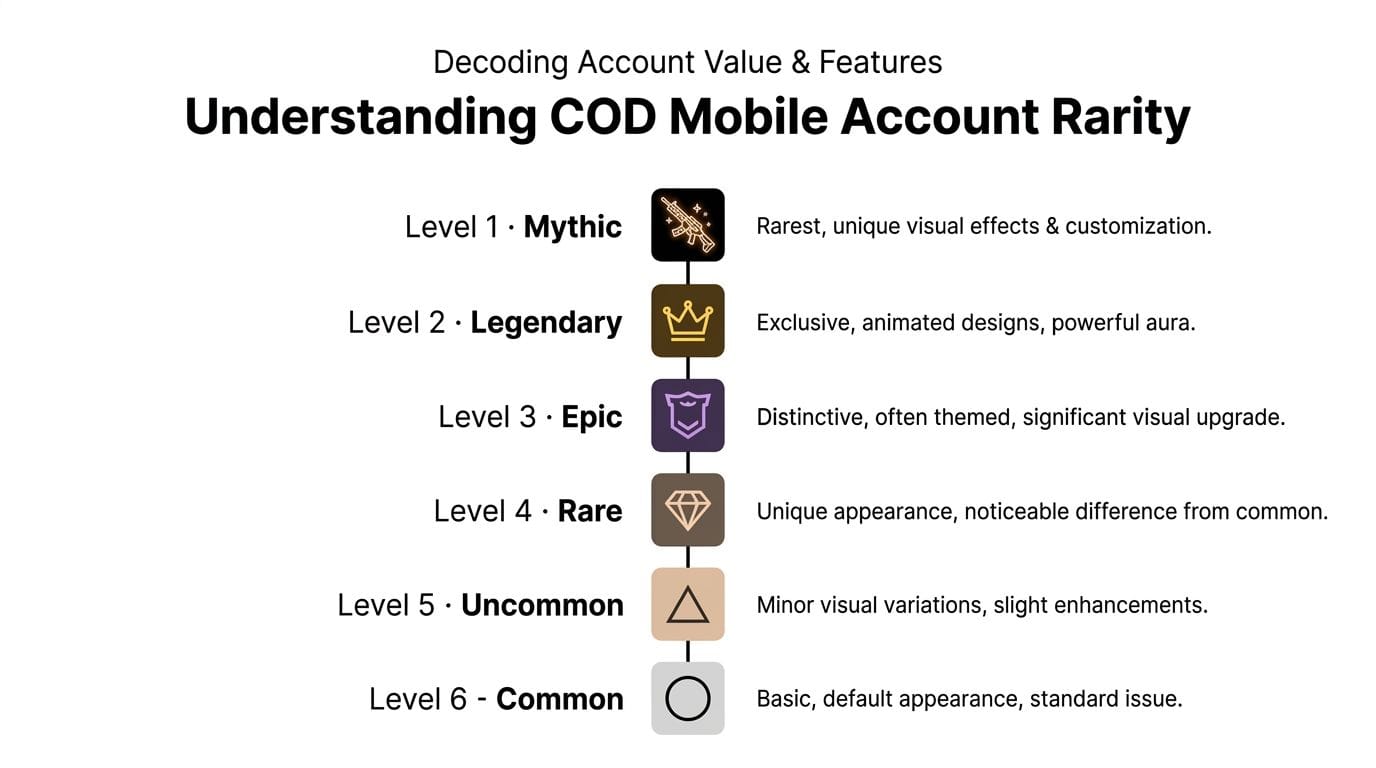
Start with mythics. They pull attention, they carry resale appeal, and they usually anchor the listing price.
That said, raw mythic count is only the first pass. A strong account also needs useful coverage across weapon classes. One flashy mythic on a weak inventory often gets priced like a collector account and plays like a budget one.
Legendary weapons still move the number in a big way, especially when they cover ARs, SMGs, snipers, and BR-friendly options. Buyers pay more for accounts they can use, not just flex in a lobby.
A balanced collection beats a one-item listing
I’d take a well-rounded account over a top-heavy account every time.
Look for a collection that gives you options:
- Weapon depth: Multiple strong guns across different classes
- Operator quality: Rare, recognizable skins with actual collector appeal
- Usable loadouts: Builds that feel ready for ranked and BR
- Current proof: Clear inventory shots and loadout views from the present, not months ago
Sellers love to build a whole pitch around one famous skin. Ignore the sales angle and judge the full inventory. If the rest of the account is filler, the listing is overpriced.
Use valuation data as a starting point
Pricing tools are useful for setting expectations. Analysts at igitems say their COD Mobile calculator draws from more than 100,000 transactions, and their pricing model puts mythic count at the center of account value. They also note that accounts with 16 mythics and more than 75 legendaries can represent roughly $2 million in CP spent. More important for buyers, their marketplace data reports a 96% authenticity rate on curated listings compared with 71% in P2P trades (COD Mobile account calculator and authenticity benchmarks).
Here’s the practical takeaway. Mythics and large legendary collections drive price, but account safety changes the true value of the deal. A cheaper P2P listing is not cheaper if the account gets reclaimed or the transfer falls apart. Curated marketplaces earn their higher prices by reducing that failure rate.
Verifying authenticity is nearly as important as the inventory itself. A pricing tool helps you estimate market range. It does not tell you whether the seller has clean ownership, full access, or a transfer setup that won’t blow up after payment.
Three practical account tiers
You do not need a spreadsheet for every listing. Most cod mobile accounts fit into three useful buckets.
| Account type | What it usually looks like | Who it fits |
|---|---|---|
| Starter | A few premium items, limited depth, enough to avoid the empty-account grind | New players |
| Mid-tier | Good spread across weapon classes, solid operators, practical ranked value | Competitive players |
| Collector or whale | Heavy mythic and legendary count, rare cosmetics, prestige inventory | Veterans and creators |
What I’d check before I care about price
Price comes last. Fit and transfer strength come first.
- Check mythics first. They usually set the top end of the value.
- Review legendary coverage. More classes covered means better day-to-day use.
- Check operators and limited cosmetics. Some listings are worth more because of older exclusives.
- Ask for current inventory proof. Old screenshots do not protect you.
- Judge the account as a package. One great item does not fix a weak account.
A premium account that does not match your playstyle is still a bad buy.
Vetting Sellers and Verifying Legitimacy
You send the money, the login works, and you think you’re done. Two days later the password changes, the linked email was never really yours, and support can’t help because the deal happened in DMs. That is how bad CODM account buys usually go.
Seller quality matters more than a flashy inventory screenshot. A stacked account from the wrong seller is a liability.
P2P deals fail for predictable reasons
Direct trades look cheaper because they strip out the safety layer. You are relying on one person to tell the truth about ownership, linked accounts, recovery access, and delivery. That is a bad bet unless you can verify every part of the handoff.
Curated marketplaces cost more for a reason. They give you a sales trail, listing standards, dispute rules, and some level of seller screening. That structure does not remove risk, but it cuts down the easiest scams and makes account verification far easier than a random Telegram or Discord deal.
Use this checklist before you pay anyone.
| Trust Signal | What to Check |
|---|---|
| Sales history | Repeated CODM sales, account age, and buyer feedback that matches the item sold |
| Proof quality | Fresh screenshots, lobby views, UID visibility when appropriate, and current loadouts |
| Ownership clarity | Clear answers about linked email, Activision login, social binds, and what transfers with the account |
| Response behavior | Direct replies, no stalling, no pressure, no anger when you ask security questions |
| Payment safety | Buyer-protected checkout or marketplace escrow, not crypto, gift cards, or friends-and-family transfers |
| Rules and support | Written refund terms, delivery standards, and an actual dispute process |
| Platform controls | Moderation, verified sellers, review history, and visible listing structure |
Verify the seller. Then verify the account.
A serious seller can refresh proof on request. Ask for a current screenshot from the inventory screen, a recent ranked or lobby screen, and confirmation of what login methods are attached. If they cannot do that, stop there.
Ask one more question that scammers hate. "What exact steps will I follow to gain full control after payment?" Honest sellers answer cleanly. Scammers get vague because they do not control the account well enough to promise a safe transfer.
One example is IceSoul, which lists CODM accounts in a marketplace format with categorized inventory, pricing, and support channels. That setup is safer than trusting a random DM because you can inspect the listing, the seller profile, and the platform rules before any money leaves your account.
Red flags that should kill the deal
Cheap prices do not cancel out recovery risk.
Walk away if you see any of these:
- Rush tactics: "Another buyer is paying in ten minutes."
- Old or cropped proof: They avoid fresh screenshots or hide parts of the screen.
- Off-platform pressure: They push you into private payment after first contact on a marketplace.
- Transfer vagueness: They cannot explain linked accounts, original email access, or recovery exposure.
- Payment traps: They insist on irreversible payment methods only.
- Defensive behavior: They act offended when you ask basic ownership and transfer questions.
A trustworthy seller treats security questions like part of the sale. A scammer treats them like a problem.
The Secure Purchase and Account Transfer
At this stage, buyers either secure the account properly or lose it later because they got lazy for ten minutes.
The transfer window matters. A lot.
Data from more than 10,000 marketplace transactions shows verified sellers reach a 92% smooth transfer rate, and the biggest danger is delaying the credential change because Activision account recovery succeeds in 87% of cases for the original owner when the linked email stays unchanged within the first 24 hours (COD Mobile transfer benchmarks and recovery risk).
That tells you exactly what matters. Buy from a verified seller. Change credentials immediately. Not later tonight. Not after a few matches. Immediately.
Before you pay
Use a payment method with buyer protection. If the deal requires blind trust and irreversible payment, skip it.
Ask the seller what you’ll receive at delivery. You want to know whether you’re getting email access, Activision login details, and any linked account information needed to complete the handoff.
Do not improvise this part.
The first ten minutes after delivery
The second credentials arrive, you should already know your order of operations.
- Log in on your own device. Confirm the account is real and matches the listing.
- Check the key inventory items. Verify the mythics, legendaries, operators, and rank claims that justified the purchase.
- Change the password. Do this first.
- Change the linked email if possible. This closes the biggest recovery window.
- Review every linked method. Look for social or platform bindings that still provide the old owner control.
If anything doesn’t match the listing, stop and document it before doing anything else.
Don’t turn verification into a long gaming session
A lot of buyers make the same dumb mistake. They receive the account, admire the skins, queue a few matches, and tell themselves they’ll finish security later.
That’s how recovered accounts happen.
Your first job is ownership control, not testing the mythic inspect animation.
A short visual walkthrough can help if you’re new to the process:
What a clean transfer looks like
A good transfer feels boring. That’s what you want.
You receive credentials. You log in. The account matches the listing. You change the login details. You verify there are no old backdoors left open. Then you test that the new credentials work consistently on your device.
If the seller keeps interrupting that process, asking you to wait, or telling you not to change details yet, that’s a major warning sign. There’s no good reason to delay lockout once payment is complete and the account is delivered as promised.
Securing Your New Account Post-Purchase
Buying the account isn’t the finish line. It just gets you into the room. Security hardening is what keeps the account yours.
This is the part impatient buyers skip, then regret later.
Lock every door you can find
Start in the account settings and work through every linked login method. If an old owner still has any route back in, you don’t fully control the account.
Your post-purchase checklist should look like this:
- Change the main password: Use a password you haven’t used anywhere else.
- Replace the linked email: Use an email account that only you control.
- Enable 2FA: Don’t treat this as optional.
- Review connected sign-ins: Remove or replace any old bindings that still point to the seller.
- Retest login access: Sign out and back in using only your new credentials.
The goal is simple. No shared access. No leftover recovery paths. No assumptions.
Keep your setup clean
Don’t start lending the account around to friends. Don’t log into it from random devices you don’t control. Don’t leave old credentials sitting in screenshots, chats, or notes.
If you bought the account to keep, act like the account matters.
A clean owner does three things consistently:
| Security habit | Why it matters |
|---|---|
| Uses a private email for the account | Reduces recovery and takeover risk |
| Keeps credentials off shared devices | Cuts accidental exposure |
| Reviews account links after any issue | Catches leftover access paths early |
Watch for delayed problems
Some recovery attempts don’t happen right away. A dishonest seller may wait until you relax.
That means you should pay attention to login alerts, unexpected password reset activity, or any signs that linked details changed without your input. The moment something feels off, review every account binding again.
The safest buyer is the one who assumes the first week is still part of the transfer.
Understanding Inherent Risks and Terms of Service
Let’s be honest. Buying and selling accounts carries risk even when the seller looks legit.
Account trading can conflict with Activision’s rules. That means you’re never operating in a zero-risk environment. If you want absolute policy safety, don’t buy an account. That’s the clean answer.
The main risk isn’t always the platform
Most buyers focus on ban fear first. In practice, the uglier risk is often seller recovery.
That’s why random P2P deals are such a bad gamble. You can inspect the skins, inspect the rank, inspect the screenshots, and still lose the account later if the original owner kept a recovery path open.
Curated marketplaces reduce that risk because they add process. They usually force better listing detail, clearer delivery expectations, and some kind of dispute framework. None of that eliminates risk. It does reduce the number of dumb ways a deal can fail.
Choose controlled risk over reckless risk
You’re not picking between perfect safety and danger. You’re picking between managed risk and unmanaged risk.
Managed risk looks like this:
- Structured listings: Enough detail to inspect before buying
- Documented delivery: A clear trail of what was promised
- Support channels: Someone to contact if transfer details go sideways
- Security-first behavior: Immediate credential and binding changes after delivery
Unmanaged risk is the opposite. A Telegram DM. Cropped screenshots. Pressure. Direct payment. Vague promises.
That’s not a strategy. That’s volunteering to get scammed.
Frequently Asked Questions About Buying CODM Accounts
Is buying cod mobile accounts worth it
Yes, if you value time more than grind and you buy carefully. No, if you’re chasing the absolute cheapest listing and ignoring security.
What matters most in account value
Mythics usually get the most attention, but overall account quality matters more than one flashy item. A good spread of weapons, operators, and usable loadouts beats a one-item flex account.
Should I buy from a random player in DMs
I wouldn’t. Direct deals remove most of your protection and make recovery scams much easier.
What should I do right after purchase
Log in, verify the inventory, change the password, replace linked credentials where possible, and secure every binding before you play.
Can I remove all risk
No. You can reduce risk a lot with better seller selection and immediate post-purchase hardening, but you can’t make account trading completely risk-free.
If you want a marketplace-style option instead of gambling on random P2P sellers, browse IceSoul with the same mindset from this guide. Check the listing details, verify what’s included, and treat security after delivery as mandatory.
Crafted with Outrank