
You’re probably here because you’re tired of staring at CODM clips with mythic guns, stacked operator skins, and polished loadouts while your own account still looks like a starter pack. Or maybe you used to grind hard, took a break, and now you don’t feel like sinking weeks back into progression just to be competitive again.
That’s exactly why the phrase call of duty account for sale gets searched so often. Players want a shortcut, but they don’t want to get robbed, banned, or handed a trash account full of old cosmetics that don’t matter anymore. Fair enough. I’ve seen all three happen.
The demand exists because Call of Duty is massive. The franchise has passed 500 million units sold lifetime, with more than 30 billion U.S. dollars in consumer spending, and the mobile side alone has generated over 1.7 billion U.S. dollars, which helps explain why buyers chase pre-loaded accounts with premium gear so aggressively, according to VGChartz coverage of Call of Duty franchise sales and spending.
CODM account buying can be smart. It can also go sideways fast if you treat a mobile account the same way you’d treat a console profile. That’s the mistake most generic guides make.
Table of Contents
- Why Buy a Call of Duty Account
- Decoding the Value of a CODM Account
- The Real Dangers of Buying Accounts
- How to Vet a Seller and Verify a Listing
- The Secure Account Transfer and Payment Process
- Why a Curated Marketplace Like IceSoul is Safer
- Final Checklist for Your First Account Purchase
Why Buy a Call of Duty Account
A good CODM account saves time. That’s the whole point.
If you’re new, it gives you a head start with weapons, skins, and progression that would otherwise take a long grind or a lot of spending. If you’re a veteran, it lets you target what you care about, like a specific mythic blueprint, a rare operator, or a ranked-ready setup without rebuilding from zero.
The grind isn’t the goal for everyone
Some players enjoy the climb. Others just want to log in and play with the gear they like. There’s nothing wrong with that.
I’ve watched plenty of players waste money chasing one flashy item through in-game systems, then end up with less than they wanted. Buying the right account can be a cleaner move if the listing has real value and the transfer is handled properly.
Practical rule: Buy an account to skip dead time, not to impress yourself with a long inventory screenshot.
The buyers I trust most usually fall into one of these groups:
- New players who want to enter ranked or BR with a stronger start
- Returning players who missed major seasons and don’t want to rebuild
- Collectors who care more about rare cosmetics than raw progression
- Competitive players who want usable loadouts now, not later
A big market attracts both opportunity and garbage
Because Call of Duty is so big, the secondary market is full of listings. That’s the good news and the bad news. You’ll find serious sellers, lazy resellers, stolen accounts, bot-farmed profiles, and old CODM accounts priced like museum pieces for no good reason.
A call of duty account for sale listing only makes sense when the account solves a real problem for you. If you mostly play BR, vehicle skins and BR-ready gear matter more than random MP cosmetics. If you play ranked aggressively, weapon quality and practical loadouts matter more than a pile of legacy junk.
That’s where buyers get trapped. They shop with emotion first, then they notice the missing details after payment.
Buy with a purpose. Skip the fantasy. Treat the account like an asset you’ll use.
Decoding the Value of a CODM Account
A CODM account isn’t valuable just because the seller writes “stacked” in the title. Value comes from what you can use, what you can keep, and what still matters in the current game.
What actually makes an account worth buying
Start with the obvious stuff, but don’t stop there.
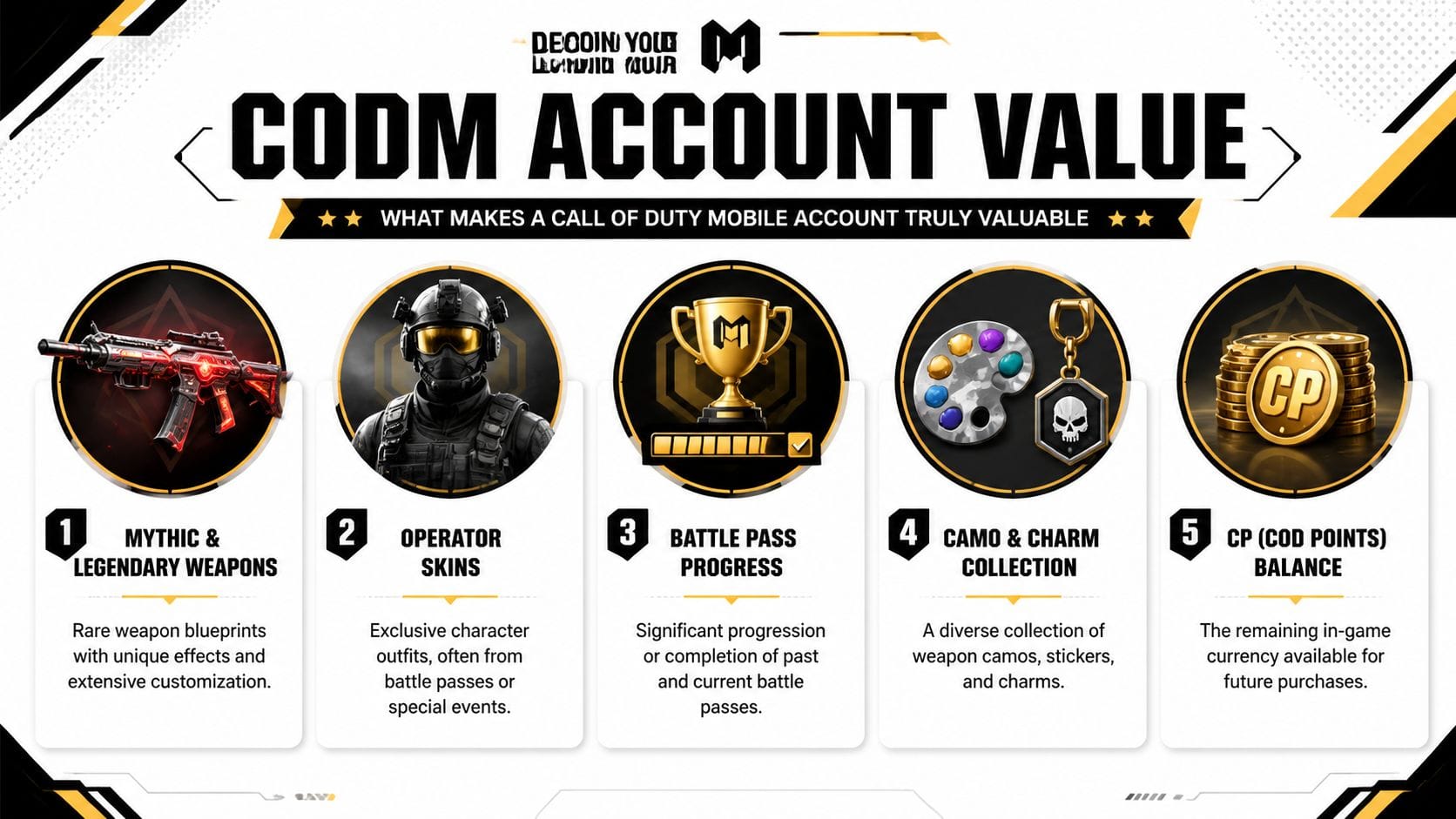
The strongest listings usually combine several layers of value:
- Mythic and legendary weapons that are still desirable, not just numerous
- Operator skins with real rarity or recognizable event history
- Battle pass progress that shows the account wasn’t built yesterday
- Camo, charm, and cosmetic depth that adds collector value
- CP balance if any remains and is clearly shown in proof
That last point matters less than sellers pretend. A leftover currency balance is nice, but it shouldn’t be the reason you buy. Skins and usable weapons carry the deal.
A smart buyer also checks practical strength. Before paying for a flashy account, compare its weapon pool against the best Call of Duty Mobile guns 2026. If the listing is loaded with cosmetics but weak on current usable options, the seller is charging for nostalgia.
How to judge value instead of hype
CODM accounts lose value when their loadouts stop matching the current meta. That’s not theory. Over the last 12 months, CODM seasonal updates devalued 40% of legendary operator skins from prior seasons, and 35% of veteran buyers resell accounts within 3 months at a 50-70% loss when the loadouts aren’t optimized for current ranked play, according to market data discussed by Z2U.
That one fact should change how you shop.
Don’t overpay for an account built around old prestige items if you want performance. A collector account and a ranked account are not the same product, even if both look expensive.
| Method | Estimated Cost (Euros) | Time Investment | Included Assets |
|---|---|---|---|
| Buy one in-game mythic through normal spending | Higher and item-limited | High | Usually centered on a single item path |
| Buy a curated CODM account | Varies by listing | Low | Can include multiple weapons, skins, progress, and extras |
The table stays simple for a reason. In-game cost structures vary, and sellers often inflate comparisons. What matters is whether the account gives you concentrated value that would be expensive or annoying to recreate.
Buy for relevance. A rare skin that never leaves your inventory is a trophy. A strong weapon plus the right supporting items is something you’ll actually use every day.
Here’s the checklist I use when judging price:
- Main draw. What is the account really selling? Mythics, legacy skins, BR cosmetics, ranked utility, or all of it?
- Depth. Are there only headline items, or is the whole inventory solid?
- Proof. Can the seller show the claimed weapons, operators, and progression clearly?
- Use case. Does this fit MP, BR, collecting, or streaming?
- Resale reality. If you had to move it later, would another buyer still want it?
That’s how you stop buying screenshots and start buying actual value.
The Real Dangers of Buying Accounts
You pay, the seller sends the login, and the inventory looks perfect. Two days later, the account is gone, support sides with the original owner, and your money is dead with it.

Recall scams are the top threat
The biggest danger is simple. You pay for access, but the seller still keeps control.
That happens through the original email, linked Facebook or Google account, recovery options, old receipts, or enough account history to convince support that the account should be returned. Buyers who only change the password get trapped here all the time. Password access is not the same as ownership.
A recall does not look dramatic at first. The handoff feels normal. Then support reverses it, the seller disappears, and you are left trying to prove ownership of an account that was never fully transferred in the first place.
If you remember one rule, use this one: an account is only safe when the recovery path moves with it, not just the login screen.
Bans hit buyers for the seller's history
The second danger is enforcement. A bad account can already be marked for trouble before you ever touch it.
CODM buyers make a common mistake here. They assume safe play after purchase will protect them. It will not. If the account was botted, boosted, used with cheats, mass-logged across regions, or built with suspicious progression, you inherit that baggage.
This matters more in Call of Duty: Mobile because mobile behavior leaves its own trail. Device changes, sudden region swaps, odd login patterns, and inventory that does not match play history can all make an account look wrong. A stacked cosmetic inventory on a weak profile is not a flex. It is a warning.
If a seller is offering high-end skins on an account with thin match history, poor progression, or sloppy proof, treat it as contaminated stock.
CODM has mobile-specific weak points that generic guides miss
Many account-buying guides falter at this point. They talk like every Call of Duty account works the same. CODM does not.
Mobile accounts often sit on layered login systems. Activision access may be only one piece of the account. Facebook, Google, Apple, and device-linked habits can all affect control and recovery. If even one of those links stays with the seller, your purchase stays exposed.
CODM also gets more cosmetic-first buyers than PC or console markets. Scammers know that. They build listings around mythics, legendary operators, and flashy screenshots because buyers get distracted by the inventory and stop asking the only question that matters. Can this account stay in my hands after the transfer?
That is why curated CODM marketplaces matter more here than in generic account trading. A CODM specialist checks the transfer path, not just the item list. IceSoul's value is not hype. It is the fact that curated CODM listings, community proof, and dedicated support reduce the exact failures that kill most first-time purchases.
Buyers lose money when they shop by skin count alone. Smart buyers check whether the seller can hand over control cleanly, survive account review, and leave no route for a clawback.
How to Vet a Seller and Verify a Listing
Most scams are easy to spot if you stop acting like a fan and start acting like an auditor.
What to ask before you pay
Start with the seller, not the account. A clean listing from a bad seller is still a bad deal.
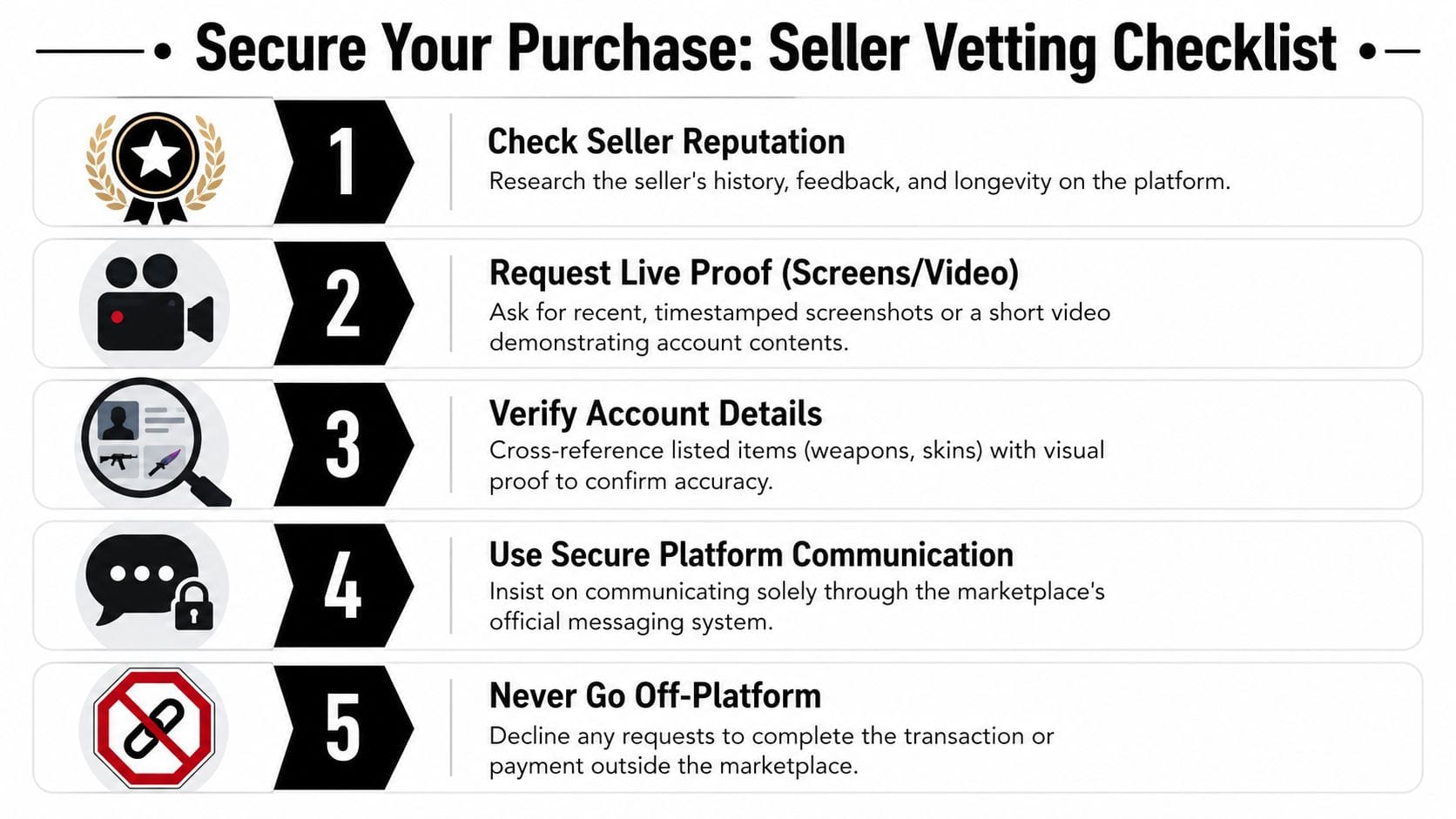
Use this short process:
- Check platform history. Look for long-term presence, not a fresh profile with polished sales language.
- Ask for recent proof. Request fresh screenshots or a short video that matches the listing.
- Confirm ownership path. Ask what login method the account uses and what exactly transfers with it.
- Keep all communication inside the marketplace. If the seller pushes you off-platform early, treat that as a warning.
- Watch how they answer. Serious sellers respond clearly. Scammers dodge, rush, or get aggressive.
A seller who can’t explain transfer details is not a seller. He’s a future problem.
Red flags inside the listing itself
The account itself tells a story if you know what to look for.
Some listings scream trouble right away:
- Cosmetic overload with weak progression. Premium skins on an account that looks barely used
- No gameplay proof. Only cropped inventory screenshots, no broader profile view
- Messy stat profile. Strange progression patterns, suspicious performance spikes, or a profile that doesn’t look hand-played
- Too-cheap urgency. “Need gone now” prices can mean stolen access, weak ownership, or a damaged account
- Missing login details. If the listing avoids saying how the account is linked, stop there
You also want the seller to show consistency. If they claim a high-end account, the account should look lived in. Match history, progression, skin depth, and practical gear should line up.
A believable CODM account has a personality. A fake or unstable one usually looks assembled.
I also judge listings based on whether they fit a specific player type. A BR-focused account should show BR value. A ranked account should show usable weapons and coherent progression. A collector account should have meaningful rarity. If the listing tries to be everything at once, it’s usually hiding something.
This is why vetting matters. The anti-cheat source already tells us resold profiles can get flagged fast, while cleaner hand-leveled accounts perform much better against ban waves. That means your job before purchase is simple. Filter out the suspicious history before it becomes your problem.
The Secure Account Transfer and Payment Process
If the seller passes vetting, the actual work starts. The transfer is where buyers either secure the account properly or hand the seller a perfect chance to steal it back later.

What a proper handover looks like
A safe handover is not “seller sends login, buyer says thanks.” It’s a controlled transfer of every meaningful access point.
Here’s the order I recommend:
- Confirm the exact linked login method before payment is finalized
- Take control of the original email or the primary login path tied to the account
- Change the account password immediately
- Change recovery details immediately after that
- Set up app-based 2FA
- Review linked services and remove anything the seller could still use
- Log out old sessions where possible
- Check the account calmly before you start heavy play
That’s the baseline. Skip any of it and you leave a door open.
For buyers who also spend inside the game after purchase, it’s smart to separate account buying from future top-ups. If you plan to add CP later, look for practical ways to reduce your spend, like IceSoul for Google Play savings, instead of making rushed in-game purchases right after transfer.
Payment rules that keep you alive
Your payment method matters almost as much as the handover.
Never reward a seller for reducing your protection. If someone offers a “better deal” only if you pay directly in a way that removes dispute options, you’re being set up. The lower price is bait.
Keep these rules tight:
- Use buyer-protected payment routes when available through the platform
- Never split the deal across private chats and off-platform payment
- Do not send “friends and family” style payments for account trades
- Keep screenshots of the listing, agreement, and handover process
- Do not mark anything complete until access is fully secured
A good transfer feels slightly boring. That’s what you want. No rush, no confusion, no last-minute changes.
The moment a seller starts improvising during transfer, slow everything down. Honest account handovers get cleaner as they progress. Scam handovers get messier.
Why a Curated Marketplace Like IceSoul is Safer
The problem with random account buying isn’t just dishonesty. It’s inconsistency. Every independent seller expects you to do your own fraud checks, your own listing review, your own transfer handling, and your own post-sale troubleshooting.
Why CODM needs specialist handling
That approach breaks down faster on mobile. Marketplaces often don’t provide CODM-specific guidance on ban rates or recovery issues around flagged Facebook and Google logins, and mobile ban rates are described as estimated 20-30% higher in that context, which is exactly the gap specialist platforms can address with verified listings and targeted support, according to the cited COD account marketplace reference.
That’s why I prefer specialist handling for CODM over broad “we sell every game account” marketplaces. Mobile accounts have their own failure points. If the platform treats CODM like just another generic listing category, the buyer does the hard work alone.
What a curated process changes
A curated marketplace reduces the number of things that can go wrong before you ever click buy.
Instead of guessing, you want a setup where the account has already been screened for obvious issues, the listing is structured clearly, and support exists if the handover gets messy. That’s the practical case for browsing premium CODM accounts on a specialist marketplace like IceSoul, which focuses on CODM listings, categorizes account options, and provides direct support channels that fit this kind of purchase.
Here’s what matters in a curated process:
- Focused inventory. CODM-specific listings are easier to compare when the seller isn’t mixing every game under the sun
- Clearer proof. Better listings usually show what buyers care about instead of hiding behind vague descriptions
- Support after purchase. That matters more on CODM because login and recovery issues can be more annoying on mobile
- Community visibility. A known presence with public feedback is easier to trust than a disposable seller identity
This doesn’t make account buying risk-free. Nothing does. But it cuts out a lot of the chaos that burns first-time buyers.
And that’s the point. You shouldn’t need detective-level effort just to buy a CODM account without getting hit by a recall, a dirty history, or a broken handover.
Final Checklist for Your First Account Purchase
If this is your first account buy, keep it simple. Don’t chase the flashiest inventory first. Chase the cleanest deal.
Use this checklist before you commit:
- Know why you’re buying. Ranked advantage, BR setup, collecting, or content creation
- Judge the account by current usefulness. Old cosmetics alone don’t justify the price
- Demand proof that matches the listing
- Check the seller’s history before you check out
- Confirm every linked login path
- Secure full control during transfer
- Use protected payment methods
- Walk away if the seller gets pushy, vague, or sloppy
The safest purchase usually isn’t the cheapest listing. It’s the one with the fewest unanswered questions.
A good call of duty account for sale deal should feel controlled from start to finish. You understand what you’re buying. You understand the account’s real value. You understand the handover process. And you don’t let a seller rush you into trusting loose ends.
That’s how experienced buyers stay out of trouble. They don’t just shop for skins. They shop for ownership, stability, and fit.
If you want a simpler path, browse IceSoul for CODM-focused account listings, clear pricing, and direct support built around the kind of transfer issues mobile buyers run into.