
Most players expect a simple answer to what is the rarest skin in fortnite. The surprising part is that the community's most famous answer and the data-based answer don't always point to the same kind of rarity.
If you're asking for the skin with the strongest overall claim in 2026, Renegade Raider still sits at the top of the conversation because of how it was originally sold, how few people could even reach the requirement in early Fortnite, and how rarely it shows up in actual matches. But if you're asking who has the lowest verified ownership among some promo skins, the answer gets messier fast. That's where leaked ownership data changes the usual Reddit and YouTube ranking debates.
Rare in Fortnite doesn't mean one thing. It can mean old. It can mean hard to obtain. It can mean locked behind hardware. It can mean never reissued. It can even mean a re-release created a newer variant that is technically scarcer, while the older one still carries more social weight in lobbies.
Table of Contents
- The Search for Fortnite's Rarest Skin
- The Anatomy of Rarity in Fortnite
- The Most Famous Rare Skins Profiled
- Beyond Hype A Data-Driven Look at True Rarity
- How Rarity Evolves with Re-Releases and New Styles
- The High Stakes of the Rare Skin Economy
- A Collector's Guide to Verification and Safe Acquisition
- Frequently Asked Questions About Rare Fortnite Skins
The Search for Fortnite's Rarest Skin
The best 2026 answer is still Renegade Raider, but only if you define rare the right way.
Collectors argue about this because Fortnite has never had a single rarity system that covers every skin cleanly. Community consensus still puts Renegade Raider at the top, yet that answer gets stronger or weaker depending on what standard you use. If you care about prestige, one skin wins. If you care about estimated ownership, a promo skin or regional exclusive can make a real case. If you care about whether a skin can still return, the ranking shifts again.
That distinction matters because "rarest" in Fortnite usually gets flattened into "oldest" or "most famous." Those are easy shortcuts, and they miss the point. A skin becomes rare when the original path to get it was narrow, the eligible player pool was small, and Epic never gave the broader player base a second shot through a later release or near-identical replacement style.
Renegade Raider remains the cleanest benchmark because it sits at the intersection of all three. It came from Fortnite's earliest period, it asked players to clear an access requirement before spending V-Bucks, and it carries years of community recognition that newer exclusives have never matched. In practice, that makes it the skin players mention first, the one collectors use as a reference point, and the one every other candidate has to beat.
There is still a real trade-off here.
Some skins are probably owned by fewer accounts, especially promo-locked cosmetics tied to specific hardware, regional campaigns, or short redemption windows. Those skins can be rarer in a strict ownership sense while feeling less important in matches because they never built the same cultural weight. Renegade Raider has both forms of rarity working in its favor. Scarcity helps its case, and status keeps it visible.
That is why this question stays alive in 2026. The answer is no longer just about old Chapter 1 myth. It is about weighing community consensus against ownership estimates, availability history, and Epic's modern habit of revisiting old cosmetics through re-releases, reskins, and alternate styles. By that standard, Renegade Raider is still the strongest overall answer, even if a few lower-visibility skins can challenge it on raw account count alone.
The Anatomy of Rarity in Fortnite
Rarity in Fortnite comes from distribution rules, not nostalgia alone. The skin that feels legendary in a lobby is usually the one that sat behind the hardest combination of timing, access, and return uncertainty.
Collectors often argue past each other because they mean different things by "rare." One group means low ownership. Another means high status and instant recognition. In 2026, the best read combines both, then checks how Epic has treated similar cosmetics over time. A skin with a tiny ownership pool can still matter less than a better-known cosmetic if hardly anyone recognizes it on Spawn Island.
That distinction matters more now because re-releases have changed the field. Epic has shown that long absences do not guarantee permanent scarcity, and alternate styles can preserve some prestige while still widening access. The result is a stricter test. To judge rarity well, you have to ask how the skin was distributed, who could realistically get it, and whether Epic has any pattern of revisiting that category later.
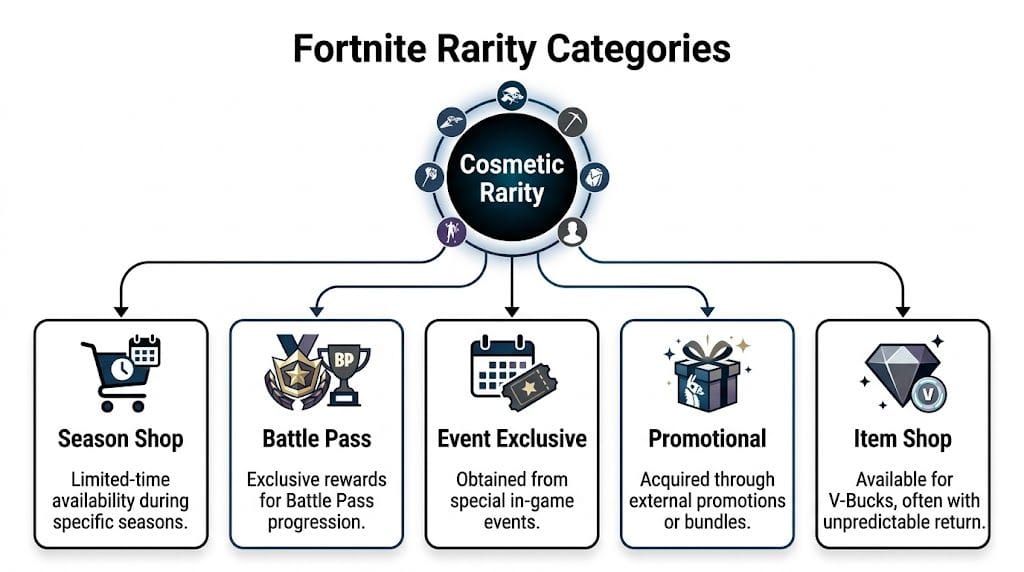
Here are the five paths that shape rarity most:
Season Shop skins
These carry early-account prestige because players had to be active during Fortnite's first live economy and meet the shop's access rules before buying.Battle Pass skins
These are time-locked by season progression. Miss the season, and the original reward track is gone.Promotional skins
Hardware bundles, phone promotions, and regional redemptions often create the smallest ownership pools. The trade-off is visibility. Some are truly scarce but never became status symbols.Event-exclusive skins
Tournament rewards and one-off collaborations can stay rare because Epic has no consistent return pattern for them.Item Shop vaults
Long gaps help, but this is the weakest rarity signal by itself. A shop skin can disappear for years and still exist on far more accounts than a tightly gated promo.
| Rarity factor | Why collectors care |
|---|---|
| Entry barrier | Shows how many players were eligible in the first place |
| Availability window | Limits how long that group had to act |
| Re-release pattern | Determines whether scarcity holds up or gets diluted |
| Community recognition | Turns ownership into visible status in-game |
I use all four factors together because any one of them can mislead. An old skin is not automatically rare. A promo skin is not automatically prestigious. A vaulted shop cosmetic is not automatically scarce enough to matter in a serious collector conversation.
For a visual example of how theme and rarity often get mixed together, Ice 2 (ice-themed skin image) looks distinctive, but visual appeal and actual ownership scarcity are separate questions.

That is the anatomy of rarity in Fortnite. Community consensus still matters, but the stronger 2026 method is to weigh that consensus against likely ownership limits and Epic's current re-release habits before calling any skin rare.
The Most Famous Rare Skins Profiled
Fortnite's most famous rare skins are not always the ones with the fewest owners. The names that stay in rotation usually sit at the intersection of scarcity, visibility, and community memory. That is why any serious 2026 ranking has to balance collector consensus with known access barriers, limited ownership clues, and Epic's history of bringing certain cosmetics back while leaving others untouched.
Renegade Raider and the original flex
Renegade Raider still anchors this conversation because it represents Fortnite before the game settled into the collection habits players know now. Early access matters, but the bigger reason it endures is social recognition. Even players who do not follow rarity lists know what the skin signals.
That signal has held up for years. In live matches, Renegade Raider works as visible proof of early participation, and that public recognition gives it a status few other skins can match. Collectors value that because rarity in Fortnite is never just about how few accounts own something. It is also about whether the lobby instantly understands what it is looking at.
Its later return changed perception, but not the skin's place in rarity history. For veteran players, the original prestige came from timing, not just current scarcity.
Black Knight and Battle Pass prestige
Black Knight is famous for a different reason. It came from an early Battle Pass, which means its gate was seasonal commitment inside Fortnite itself rather than shop timing or an outside promotion.
That distinction matters. A Battle Pass skin like Black Knight feels cleaner in collector conversations because the path was clear, the window was fixed, and the chance never came back once the season ended. Players still read it as earned, even if the actual barrier was more about grinding tiers during that season than pure skill.
It also holds up well under modern scrutiny. In a 2026 view of rarity, Black Knight may not always beat promo-locked skins on ownership scarcity, but it remains one of the strongest examples of closed, permanent availability.
Surf Strider and the promo-lock problem
Surf Strider shows why community fame and true scarcity can split apart. It never reached the same mythic status as Renegade Raider, but its acquisition path was far narrower. According to CGMagazine's guide to rare Fortnite skins, Surf Strider was tied to Intel's hardware promotion from November 2020 to July 2021 and required a 9th or 10th gen Intel CPU redemption through the Intel Gaming Access app.
CGMagazine also notes in that same breakdown that the skin has been absent from the Item Shop for more than 1,400 days and appears in under 0.001% of lobbies. That combination is why promo skins create harder collector questions than standard OG cosmetics. Access was limited before rarity even entered the discussion.
I have seen newer players underrate skins like this because they were never turned into major montage culture icons. Collectors usually look at them differently. If the entry route depended on specific hardware, a narrow claim window, and a one-time code path, the owner pool can stay small even without broad community hype.
If you like comparing how collectors visually judge themed cosmetics, this old Ice 2 (ice-themed skin image) style reference is a useful reminder that visual identity and ownership scarcity are separate questions.
A quick video recap can help if you want the community-facing version of these debates:
Why some famous skins feel rarer than they are
Aerial Assault Trooper, Ghoul Trooper, Skull Trooper, and Recon Expert all matter, but they became famous through different paths. Some gained prestige from early release timing. Some built their reputation through long absences. Some became more complicated after Epic reintroduced them and changed how players viewed "OG" ownership.
That is where rankings usually go off course. One collector is judging historical access. Another is judging how rarely the skin appears in current matches. Another is judging how much status the name still carries in the community. All three lenses matter, and they do not always point to the same answer.
The practical read looks like this:
- OG icons carry the strongest social signal in public matches.
- Battle Pass legends keep their value because the original path closed permanently.
- Promo skins often beat louder names on actual scarcity.
- Vaulted shop skins get overrated if the only metric is days since last seen.
Beyond Hype A Data-Driven Look at True Rarity
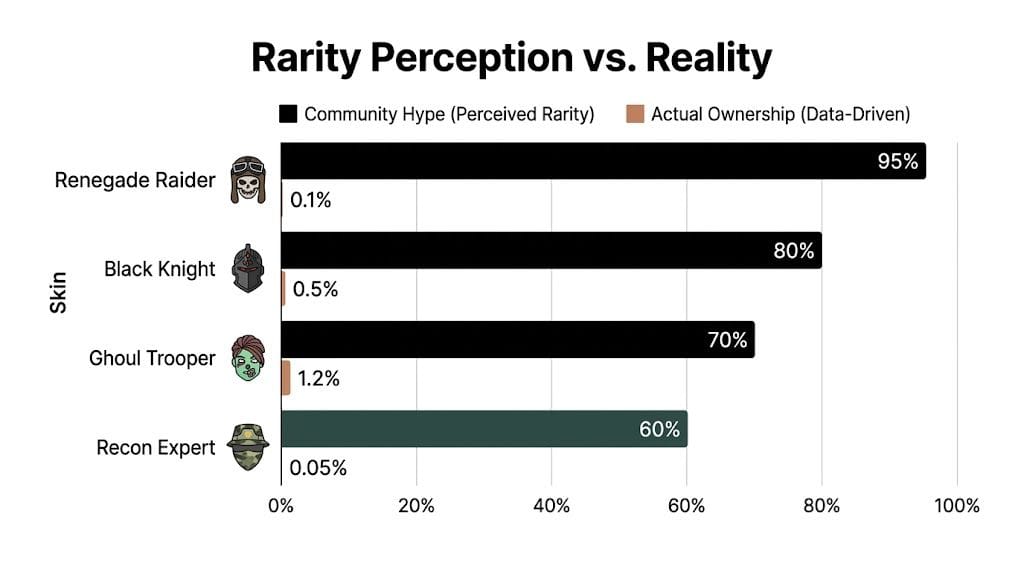
The community usually treats rarity like a popularity contest. That's where the leaked ownership view becomes useful.
What ownership data changes
When collectors only use "days since last seen," they miss a big part of the picture. A skin can vanish for years and still have a large ownership base because it was easy to buy when it was available. Another skin can have less cultural hype but far fewer owners because the promo uptake was tiny.
That's why one verified ownership figure changes the conversation so much. Honor Guard has only 47,761 verified owners globally, based on leaked Epic Games ownership data discussed in this analysis of quantitative rarity rankings. That makes it statistically rarer than many skins that get more attention in videos and listicles.
This is the key correction to common ranking culture. Vaulted doesn't automatically mean rarest. Sometimes it just means absent.
A better way to judge rarity
If you want a collector-grade answer, use a simple three-part test:
| Test | What to ask |
|---|---|
| Access test | Could most players realistically get it when it released? |
| Ownership test | How many accounts actually ended up with it? |
| Recognition test | Does the skin still carry obvious status in a live match? |
Renegade Raider scores extremely high across all three. Honor Guard scores harder on ownership than many players expect. Surf Strider scores hard on access restriction. Black Knight scores strongly on recognition and closed-season exclusivity.
Community hype often tracks nostalgia better than scarcity.
That doesn't mean community consensus is useless. It matters because status in Fortnite is social. A rare cosmetic only becomes a flex if other players understand what they're seeing. Still, once you bring ownership counts into the conversation, a lot of "top rarest" lists start to look more like nostalgia rankings than scarcity rankings.
A practical collector approach is to separate skins into two buckets:
Status rare
Famous, instantly recognized, culturally powerful.Statistically rare
Lower ownership, often less celebrated, sometimes more obscure.
The strongest 2026 answer combines both buckets instead of pretending they are the same thing.
How Rarity Evolves with Re-Releases and New Styles
Fortnite skin rarity is never permanent. Epic can change a cosmetic's place in the hierarchy with a single shop return, an exclusive edit style, or a crossover that loses its licensing window.

When a return changes rarity instead of erasing it
Collectors get tripped up here all the time. A shop comeback does not always flatten rarity into "common now." It often splits the skin into separate layers of value.
The base cosmetic may become easier to get again. The original acquisition window still matters. In some cases, Epic adds a style that creates a new scarcity tier on top of the old one. That is why the conversation around Renegade Raider's 2025 OG Season Shop return got so messy. The skin returned, but the return did not erase the prestige tied to early ownership, and the added style created a different kind of scarcity, as discussed in this video on evolving Fortnite rarity trends.
For longtime players, that difference is obvious in matches. A returned skin can still read as "old account" if the owner has the right variant, banner history, or timing behind it. For newer players, the locker entry looks the same at first glance. That gap is why community consensus and ownership-based analysis can point in slightly different directions in 2026.
New styles can shift the collector hierarchy
Styles complicate rarity more than re-releases do.
An added style can be less owned than the original version while carrying less cultural weight. That sounds contradictory until you separate scarcity from status. A technically lower-ownership variant is not always the version players care about most. In Fortnite, the first release usually holds the stronger story. The later style may end up rarer on paper, but the original still carries the cleaner "I was there" signal.
This trade-off matters if you're trying to answer the rarest skin question seriously. Are you measuring the least-owned cosmetic state, or the skin with the strongest blend of scarcity, recognition, and historical importance? Those are different rankings.
Some skins become rare because their return path disappears
Outside factors matter too. Crossovers do not follow the same rules as original Fortnite skins. Their rarity can harden because the business context changes, not because Epic wants to protect exclusivity.
Kelsier is the kind of example collectors keep watching. If a collaboration loses its promotional timing or the underlying rights situation changes, the skin can sit in the vault for years without any formal "exclusive" label. That creates a different form of rarity from early Battle Pass or Season Shop cosmetics. It is less about veteran identity and more about a closed return window that may never reopen.
That is why re-release trends matter as much as age. In 2026, the strongest rarity analysis tracks three moving parts at once:
- Shop availability history, which shows how often players had a fair shot to get the skin
- Ownership concentration, which helps separate famous skins from scarce ones
- Style and licensing changes, which can create new rare variants or freeze old ones
Collectors who only track last-seen dates miss half the story. The better question is why a skin stayed gone, and what would need to happen for it to return.
That lens keeps you from overrating every vaulted cosmetic and helps explain why some skins lose rarity fast, while others get harder to categorize every year.
The High Stakes of the Rare Skin Economy
Rare Fortnite skins don't just affect locker bragging rights. They shape an unofficial economy built around accounts, reputation, and risk.
Why buyers chase these lockers
People buy or hunt rare-skin accounts for a few reasons. Some want veteran status without having played early seasons. Some want content value for streaming or social clips. Some are pure collectors who care more about digital history than gameplay.
Renegade Raider sits at the center of that because scarcity plus recognition is the strongest combination in this space. The verified data around it also notes that its scarcity has amplified black-market value relative to its original V-Bucks cost in secondary trading conversations, which is part of why scams cluster around the skin. Once a cosmetic becomes both famous and hard to replace, sellers know it can trigger impulsive buyers.
The problem is that Fortnite doesn't support this as a normal collectible market. You're not trading items through an official skin exchange. You're dealing with account control, login trust, recovery risk, and platform rules.
What usually goes wrong
Most bad outcomes follow a familiar pattern:
- The seller can't prove original ownership and is reselling a compromised account.
- The buyer gets shown edited locker evidence instead of live verification.
- The account gets recovered later because the original creator still has enough details.
- The transaction breaks Epic's rules, leaving the buyer with no meaningful protection.
A lot of new collectors focus on the skin list and ignore the account history. That's backwards. In practice, account provenance matters more than the rare cosmetic names attached to it.
What doesn't work is:
- Trusting screenshots alone
- Assuming "OG" means authentic
- Paying extra for hype words without proof
- Treating social media middlemen like escrow
And here's the harder truth. Even when the locker is real, the account can still be unstable. Rare cosmetics create urgency, and urgency is exactly what scammers need.
The rarer the locker claim, the more proof you should demand, not the less.
A Collector's Guide to Verification and Safe Acquisition
If you're serious about rare Fortnite cosmetics, verification has to come before excitement.

What to verify before you trust a claim
For top-tier skins, start with provenance, not cosmetics. With Renegade Raider, collector guidance in the verified data specifically points to checking the inspect tool for Season 1 provenance to distinguish original ownership from later confusion. With Surf Strider, the verified data recommends checking for the Intel promo bundle flag in inventory records to confirm that the skin came through the actual hardware promotion.
That kind of verification is more useful than broad statements like "stacked OG account" or "rare locker." Anyone can write those. Fewer people can show the correct ownership markers in a way that holds up under scrutiny.
Use this checklist when someone makes a high-value rarity claim:
Ask for live locker verification
Not a cropped screenshot. Not a montage clip. A live view is harder to fake.Check the skin's acquisition story
Does the claimed origin match how the cosmetic was distributed?Look for provenance markers
Season-linked or promo-linked indicators matter more than hype.Review account consistency
An account with disconnected history often raises more questions than answers.
What works and what doesn't
Collectors who stay safer tend to be boring on purpose. They slow the process down, verify details, and walk away fast when the story shifts.
| Works | Doesn't work |
|---|---|
| Asking specific origin questions | Accepting vague "trust me" answers |
| Verifying metadata and locker details | Relying on edited screenshots |
| Prioritizing account history | Focusing only on the rarest skin name |
| Walking away from pressure tactics | Rushing because the skin sounds elite |
I also recommend treating any "one-time deal" language as a warning sign. In this niche, pressure usually benefits the seller.
A few practical habits help:
- Document everything before any payment discussion.
- Cross-check the claim against known release method instead of forum myths.
- Favor patience over exclusivity pressure.
- Assume that real rarity attracts fake listings.
No method makes account trading risk-free. The goal is reducing obvious mistakes, not pretending the space is safe.
Frequently Asked Questions About Rare Fortnite Skins
Here are the questions I hear most often from players who start digging into what is the rarest skin in fortnite.
| Question | Answer |
|---|---|
| Is Renegade Raider still the best answer in 2026? | Yes, if you're combining community consensus, original access difficulty, and lasting status. It's the strongest all-around answer. |
| Does a skin returning automatically kill its rarity? | No. A return can reduce broad scarcity, but OG ownership history can still matter, especially when Epic separates older owners from newer ones with style or provenance differences. |
| Are promo skins sometimes rarer than OG skins? | Yes. Some promotions had such restrictive access that their ownership ended up lower than more famous early skins. |
| Is buying an account with rare skins safe? | It's risky. The biggest problems are fake proof, account recovery, and rule violations. Verification helps, but it doesn't remove the core risk. |
| Do other cosmetics get rare too? | Yes. Gliders, wraps, and other cosmetics can become rare through the same forces: limited distribution, event tie-ins, and long vault periods. |
A simple final answer looks like this: Renegade Raider is still the headline answer, but true Fortnite rarity is a mix of access barriers, verified ownership, and whether Epic changes the skin's status later. That's why two collectors can both sound right while arguing about different definitions.
If you're just curious, that's enough to settle the debate. If you're collecting, true skill isn't naming the rare skin. It's knowing why it's rare, and whether that rarity is cultural, statistical, or both.
If you like rare digital cosmetics and care about verified listings, clear inventory details, and a smoother buying experience in other games, take a look at IceSoul. It's built for CODM players who want premium accounts, mythic and legendary gear, and straightforward browsing without the usual clutter.