
Most advice about what is the rarest skin in fortnite gets one thing wrong. It treats rarity like a trivia answer.
That’s why you’ll see people throw out names like Renegade Raider, Black Knight, or whatever skin they personally remember seeing the least. But being old isn’t the same as being rare. A skin can be famous, nostalgic, and still not be the best answer if you care about actual scarcity.
A better question is this: rare by what measure? Last seen date? Limited purchase window? Special promotion? Ownership count? Real-money exclusivity? Once you use those filters, the conversation gets much clearer.
For collectors, that difference matters. An old Battle Pass outfit tells you someone played early. A statistically scarce cosmetic tells you very few players ever had a real chance to get it in the first place. Those are not the same thing.
Table of Contents
- The Search for Fortnite's Rarest Skin
- How Fortnite Skin Rarity Is Actually Determined
- Meet the Contenders for the Rarest Skin Title
- How Rarity Translates to Real-World Value
- How to Verify Rare Skins and Avoid Scams
- What Rarity Means and Frequently Asked Questions
The Search for Fortnite's Rarest Skin
Ask ten Fortnite players for the rarest skin and you’ll often get ten different answers.
That happens because players mix together three separate ideas. They mean old skins, hard-to-get skins, and skins with low ownership, then treat them like the same category. They aren’t.
Take an early Battle Pass skin. It may feel rare because new players can’t go back and obtain it. That creates prestige. But prestige alone doesn’t prove the skin is the rarest overall.
A promo skin creates a different kind of scarcity. So does a starter pack with a short shelf life. So does a cosmetic tied to one platform or one retail bundle. Each path limits who could get it, and that’s where the discussion gets interesting.
Old tells you when a skin came out. Rare tells you how few chances players had to get it.
Collectors usually split the topic into buckets:
- Nostalgic rarity means a skin is strongly associated with early Fortnite.
- Access rarity means the method of getting it was unusually restrictive.
- Statistical rarity means the pool of owners appears very small.
- Market rarity means it’s difficult to obtain through legitimate means now.
This is why simple list articles often leave readers confused. They name a skin, but they don’t explain the logic behind it.
If you want the cleanest collector answer, you need a framework. You need to ask how long a skin was available, how people got it, whether it returned, and whether there’s any ownership evidence. Once you do that, one skin starts separating itself from the pack.
How Fortnite Skin Rarity Is Actually Determined
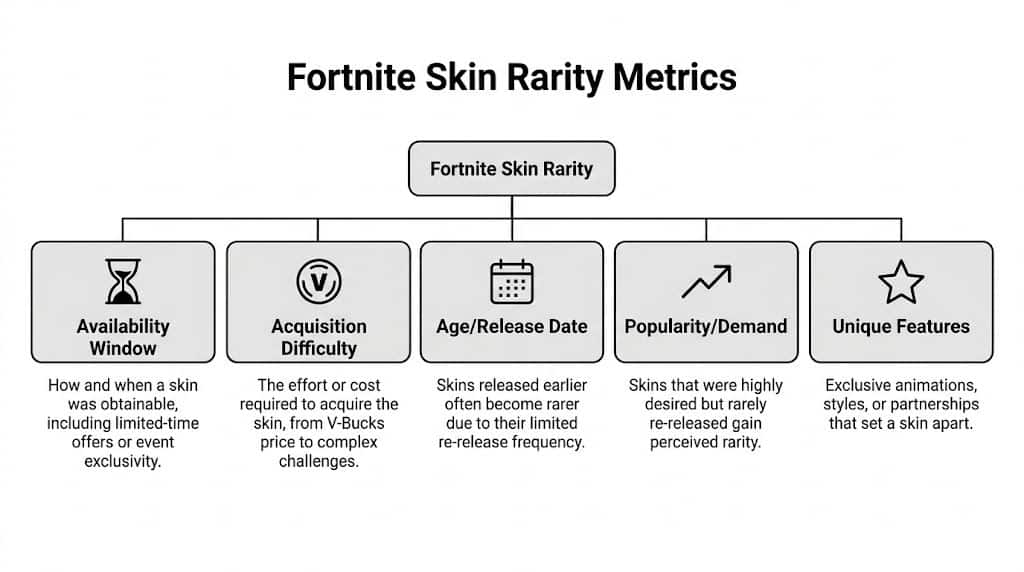
Collectors don’t just stare at a locker and guess. They use a few practical signals.
The easiest way to understand this is to think of Fortnite skins like trading cards. A card isn’t rare only because it’s old. It becomes valuable when the print run was limited, the release window was short, or access was restricted.
Days since last availability matters first
One of the clearest rarity signals is days since last availability. Analytics trackers use that metric because it’s simple and objective.
A skin that hasn’t returned for years is usually more scarce in active lobbies than one that rotates back every so often. That doesn’t automatically make it the rarest, but it gives you a strong starting point.
According to FRVR’s rarity guide for April 2026, Rogue Agent stands out because it was last seen in 2018, has had zero rotational comebacks, and is treated as a benchmark for “permanent vault” status. The same source also states that its estimated ownership rate is under 0.1% among Fortnite’s 500+ million registered accounts.
Acquisition method changes everything
How a skin entered the game matters almost as much as when it disappeared.
A normal Item Shop skin is usually easier to obtain because players can buy it with V-Bucks during its shop runs. A starter pack, hardware promotion, or platform bundle can be much more restrictive. Those methods filter the audience before demand even enters the picture.
Think about the difference:
- Battle Pass skins reward early participation.
- Item Shop skins depend on rotation and player choice.
- Starter pack skins mix timing with real-money purchase rules.
- Promotional skins can lock access behind a platform, device, or code.
That’s why two skins with similar “last seen” histories can feel very different to collectors.
Ownership data is the missing piece
Many conversations falter at this point. People say a skin is rare because they never see it. That’s not enough.
Actual ownership data is hard to find, which is why community discussions drift into opinion. But when ownership numbers do appear, they can change the whole picture. A skin may be absent for a long time and still have many owners. Another may have had fewer possible buyers from the start.
Practical rule: If you can’t separate “I never see it” from “few players ever owned it,” you’re talking about perception, not rarity.
The framework for determining rarity is as follows:
| Metric | What it tells you |
|---|---|
| Last seen date | How long the skin has been unavailable |
| Availability window | How brief or long the original access period was |
| Acquisition method | Whether access was open, limited, or platform-locked |
| Return history | Whether Epic brought it back |
| Ownership evidence | Whether scarcity is visible beyond community memory |
Using that framework, the strongest answer isn’t just “the oldest skin I remember.” It’s the skin whose release method, short access window, and complete disappearance created the smallest realistic ownership pool.
Meet the Contenders for the Rarest Skin Title
If you sort Fortnite skins by collector logic instead of nostalgia, a few names keep rising to the top. They don’t all represent the same kind of rarity, which is why comparing them is useful.
Here’s a quick view before the stories.
| Skin Name | Rarity Type | Original Availability | Last Seen |
|---|---|---|---|
| Rogue Agent | Starter pack scarcity | Paid starter pack | 2018 |
| Eon | Promotional exclusivity | Xbox promotion | Promo ended, no Item Shop return |
| Honor Guard | Ownership data example | Promotional release | Not the point here, ownership evidence is |
Rogue Agent and the starter pack effect
If you want the clearest single answer, Rogue Agent is the strongest pick.
Dexerto notes that Rogue Agent was released on March 27, 2018 as part of a $4.99 starter pack. It was available for 77 consecutive days before permanent removal. The same report says it’s regarded as the rarest Item Shop skin and was the only Chapter 1 starter pack outfit purchased with real-world money rather than V-Bucks.
That combination matters more than people think.
It wasn’t just early. It was early, paid differently, sold briefly, and never brought back. That’s a rarity stack. Each layer reduced access.
Collectors often treat Rogue Agent as the dividing line between “OG” and “statistically scarce.” If you want a visual for how heavily players value hard-to-find cosmetics, this rare skins graphic reflects the broader collector mindset around exclusive accounts and legacy lockers.

Eon and the promo code problem
Eon represents a different type of rarity.
It wasn’t defined by a short Item Shop cycle. It came through an Xbox promotional partnership, which already narrowed the audience. Once the promotion ended, access dried up. That created the sort of scarcity that collectors love and ordinary players hate.
Promo skins create confusion because some players don’t count them in the same category as standard shop cosmetics. But from a scarcity standpoint, they absolutely belong in the conversation. If access depends on a hardware tie-in or code distribution, ownership can become highly concentrated.
Old favorites versus genuinely scarce skins
Community arguments usually begin with this distinction.
Players often name skins like Black Knight because they signal early Fortnite history. That’s fair if the question is, “What skin proves someone played a long time ago?” It’s less useful if the question is, “Which skin had the most restricted path to ownership?”
The difference looks like this:
- Old and prestigious: early Battle Pass cosmetics that mark account age.
- Restricted and scarce: starter packs or promotions with unusual access rules.
- Data-supported rarity: skins where ownership evidence gives extra context.
Honor Guard is important here for one reason. It shows why ownership data changes the conversation. Leaked documents discussed in a YouTube analysis reported exactly 47,761 owners for Honor Guard, which is far more useful than “I never see it.” That number doesn’t automatically make it the rarest skin overall, but it shows how much better the debate becomes when rarity is measured instead of guessed.
So who are the top contenders? Rogue Agent is the cleanest answer for many collectors. Eon is one of the best examples of platform-locked exclusivity. Honor Guard proves why ownership counts matter. And famous OG skins remain important, even when they belong more to the “old” camp than the “scarce” camp.
How Rarity Translates to Real-World Value
Rarity in Fortnite isn’t just a bragging-rights concept. It affects how people think about account value.
Once a skin becomes unavailable for a long time, players stop treating it like a cosmetic and start treating it like a collectible. That’s when status, scarcity, and money start feeding each other.

Why buyers pay more for hard-to-get cosmetics
The strongest example here is Eon.
According to CGMagazine’s guide to rare Fortnite skins, after the Xbox promotion ended, third-party resellers priced Eon codes at over $1,000 USD on secondary markets. That’s a sharp illustration of what happens when distribution ends and demand stays alive.
The skin itself didn’t suddenly gain gameplay power. What changed was access.
When players can’t get a cosmetic through normal channels anymore, the item starts carrying three kinds of value:
- Collection value because it completes a rare locker
- Identity value because it signals exclusivity
- Resale value because scarcity attracts speculative buyers
Scarcity doesn’t make a skin stronger in-game. It makes it stronger as a signal.
Status matters as much as the skin itself
A rare skin works like a badge. In the lobby or on stream, it tells other players something about the account.
Sometimes that message is simple. “This player was around early.” Other times it says, “This account has cosmetics most players can’t realistically get anymore.” That second category tends to drive stronger secondary-market interest.
But there’s a catch. Real-world value around Fortnite cosmetics usually lives in account trading or code resales, and both come with obvious risk. You can run into fake listings, stolen accounts, or sellers who can’t verify what they claim.
That’s why smart collectors don’t stop at rarity claims. They ask for proof, history, and clean verification. A skin only has meaningful market value if the seller can show it’s there and under their control.
How to Verify Rare Skins and Avoid Scams
The rare skin scene attracts two kinds of people. Serious collectors and opportunists.
If someone claims an account has a rare cosmetic, treat that like any other high-value digital claim. Ask for evidence first, not promises.
What to check before trusting a rare skin claim
Start with the basics inside the account itself. A real owner should be able to show the skin in the locker and demonstrate familiarity with the account.
Use this checklist:
- Check locker presence: Ask for live proof of the cosmetic in the Fortnite locker, not just a screenshot.
- Review account consistency: The skin should fit the account’s broader age and cosmetic history.
- Ask for original context: If the skin came from a starter pack or promotion, the seller should understand how it was obtained.
- Watch for pressure tactics: Scammers rush buyers because urgency hides weak proof.
A good verification habit is comparing the seller’s claim against known rarity categories. If the story doesn’t match the skin’s acquisition path, something is off.
Ownership is often discussed loosely. A YouTube analysis of leaked rarity data noted that Honor Guard had exactly 47,761 owners, showing that actual ownership evidence can exist and that perception alone isn’t enough to judge scarcity. That same gap is why verification matters so much when someone is selling “rare.”
Collector habit: Trust live account evidence over edited images every time.
Scam patterns that keep catching players
Most scams aren't complex. They rely on excitement.
Common red flags include:
- Skin generators: fake tools that promise to add cosmetics for free
- Recovery scams: sellers who reclaim the account after payment
- Phishing pages: login forms disguised as verification tools
- Borrowed screenshots: images taken from other listings or social posts
Video guides can help players spot the pattern before they lose access or money.
The safest mindset is simple. If a rare skin claim can’t survive basic checking, walk away. Excitement about exclusivity is exactly what scammers count on.
What Rarity Means and Frequently Asked Questions
So, what is the rarest skin in fortnite?
For most collectors, the best answer is Rogue Agent. Not because it’s merely old, but because its release path, short paid availability, and permanent disappearance create a stronger rarity case than the usual nostalgic picks.
That said, the smartest answer is still a nuanced one. Some skins are rare because they’re early. Some are rare because access was restricted. Some are rare because ownership appears unusually low. If you ignore those differences, you’ll keep getting shallow answers.
The best collectors separate memory, scarcity, and market value instead of treating them as the same thing.
FAQ
Is Rogue Agent the rarest Fortnite skin?
For many players and collectors, yes. It has one of the strongest evidence-based cases because of its short starter-pack window, unusual purchase method, and complete absence from later rotations.
Does old always mean rare?
No. Old often means respected or recognizable. Rare means fewer players had a real chance to own it. Those ideas overlap sometimes, but they aren’t identical.
Can old Battle Pass skins return?
Collectors usually treat classic Battle Pass skins as part of Fortnite’s exclusivity culture. That’s one reason those cosmetics carry so much prestige. What matters for this discussion is that early Battle Pass skins are often better viewed as legacy cosmetics rather than the automatic answer to “rarest skin.”
Are promotional skins different from Item Shop skins?
Yes. A promo skin can be harder to get because access depends on a platform, hardware offer, or code distribution method. That restriction can make promo skins feel scarcer than many standard shop outfits.
Is buying accounts safe?
It depends on the seller, the proof, and the platform rules involved. The biggest risks are fake ownership claims, account recovery, and phishing. If verification is weak, the risk is high.
If you care about rare digital cosmetics, secure transactions matter as much as rarity itself. IceSoul is built for players who value authenticity, transparent listings, and a safer buying experience around premium gaming accounts and collectibles.